








Programme Overview
The top leadership in the education sector is on the vanguard of change and transformation. This has brought the spotlight on educators and academic professionals to initiate, manage and oversee an accelerated change towards meeting the objective of shaping schools and academic centers into ‘institutes of excellence’. Execution of such a transformation requires a good degree of management & leadership capacity to address any challenges that such a transformation may entail. Leadership programme for Educators and Academic Professionals is an attempt to build and enhance the leadership capacity and management know-how across school educators and academic professionals in India.
Programme Objective
The EdLEAP programme, through a mix of theory and practice, will help the top brass of school:
- To develop their understanding of leadership through contemporary practices in management and business leadership
- To discover how to manage change and build agility within the institution
- To explore and encourage the characteristics of a high-performance environment
- To improve learning outcomes in their schools through effective management
- To apply the foundations of effective leadership skills to everyday challenges faced by leaders in the milieu of school education.
- To evaluate leadership learnings & review priorities for professional development
Programme Directors


Who Should Attend
The programme is open for the top educators (principals and administrators) belonging to elementary, secondary and senior secondary levels of education across the country. This programme can also be taken up by senior teachers, with a minimum of ten years of experience, aspiring to be school leaders in future. This programme is also open to entrepreneurs in the education space and executives of EdTech firms. Leadership learning is not only informed by theory but also experiential
Eligibility
- For entrepreneurs, executives, directors and administrators in the education space, a minimum 10 years of work experience (full-time employment) is desirable.
- In the case of principals and senior teachers a minimum of 10 years of experience is desirable.
- All the experience will be calculated in the period after graduation to the day of programme start date. In case of exception, candidate will submit SOP for approval from the programme directors.
Programme Duration and Delivery
The duration of the programme is 9 months. The sessions will be delivered on TalentSprint interactive learning platform once a week, (Sunday 10 am – 1:00 pm).
Additionally, there will be two campus modules; of 4-days visit towards the beginning of the programme and the end of the programme. Attending the campus modules, is a mandatory requirement for successful completion of the programme.
Pedagogy
The pedagogy will be a combination of lectures, case studies, and workshops. In addition, doubt clearing, and peer group interaction will be facilitated through lounge sessions, if needed.Programme Content
The modules shall broadly cover the following topics:
Module 1: Education Sector Context, Policy, and Practice
In today's dynamic educational landscape, school leaders and education sector executives encounter multifaceted challenges arising from an interplay of factors related to education, politics, and socio-economic conditions. It is vital to effectively navigate complex decision-making scenarios, foster equitable learning environments, and adequately prepare oneself to lead institutions through times of rapid change and uncertainty. This module will endeavor to introduce participants of this course to the complexities of their business environment and shall involve sessions on the topics such as:
- Introduction to Education Sector Management
- Education and the Political Economy
- Education and the Socio-economic Structure
- Education in times of uncertainty and complexity
Module 2: Leadership Skills
This module is designed to develop leadership skills which are essential for any organizational success. The participants will be exposed to different facets of leadership and its application during uncertain times. Specifically, this module will guide education leaders to apply lessons and best practices from other sectors as well as to strategically think and manage change during crisis. Further, it will help them discover, develop, or harness their leadership style to steer their organizations to greater success. This module will involve sessions on the topics such as:
- Leadership Style and Vision: Theory & Practice
- Strategic Thinking for Turbulent Times
- Conflict and Crisis Management
- Leading Change and Innovation
- Organizational Culture
Module 3: Business Management Skills
This module intends to build the foundations of management skills for education leaders. Lessons from management of the firm inform and are, in turn, informed by the tenets of effective educational management. Participants will immerse themselves in the realm of business administration, gaining insights and competencies to run their own organizations more effectively. Specifically, they will be introduced to the economics of business and understand tools and frameworks related to project management, and marketing alongside digital marketing strategies. Particularly, this module will include sessions on the following topics:
- Business Economics
- Project Management and Operations
- Marketing Management
- Digital Marketing
Module 4: Financial Skills
This module aims to inculcate financial skills within the education leadership. The main objective is to help participants understand the financial health of their institutes, plan, control and make informed decisions. In particular, they will learn to analyze annual reports, manage cost, prepare budget, make decisions and control the risk. This module will include sessions on the following key topics:
- Financial Statement Analysis
- Cost Management
- Budgeting and Risk Management
Module 5: Stakeholder Management
This module focuses stakeholder management skills relevant to the leaders of education sector. This includes managing internal stakeholders such as teachers and staff, recruiting them, identifying their training needs, and embedding ethics and values within organizations. It would also focus on managing external stakeholders such as parents, vendors, media, and others through proper networking, communication, and persuasion. More specifically, this module will comprise sessions on the following topics:
- Human Resource Management, Recruitment & Development
- Communication and Persuasion
- Business Values and Ethics for School Leaders
Module 6: Data, Descriptive Stats, Decision Making
In the current, ever-evolving, and data-progressive business environment it is imperative for education leaders to engage in evidence-based decision making. The objective of this module is to enhance participants' ability to utilize data effectively in decision-making processes within educational settings. By exploring national and international data sources, analytical and statistical tools, as well as issues pertaining to the ethics and safety around data-use, participants shall develop the skills and knowledge necessary to make informed decisions, drive organizational growth, and improve educational outcomes. This module will comprise sessions on the following topics:
- National and International Data and Analysis
- Business Analytics for Growth
- Evaluation Methods
- Data Literacy in Schools
Module 7: Education Technology
This module is essential for education leaders to stay abreast of advancements in educational technology and its implications for teaching and learning. By exploring topics such as technology integration in classrooms, digitization, entrepreneurship in education, and cyber risk and security, leaders can effectively navigate the digital landscape, foster innovation, and ensure the safety and security of digital learning environments for students and staff alike. This module will comprise sessions on the following topics:
- Technology in Classrooms
- Digitization and Entrepreneurship in Education
- Cyber risk and security
Module 8: Education Sector Context, Policy, and Practice – II
Discussing public policy issues and national education policies is crucial for several reasons. Firstly, understanding the broader policy landscape allows leaders to align their strategies with national priorities and mandates. Secondly, it empowers them to advocate for effective policies that address the needs of diverse stakeholders and drive positive change within the education system. The concluding module shall focus on dialogues and discourses on the wider educational context, trends, and policies, including but not limited to the following topics:
- Education Policy and Research Trends
- National Policies such as the National Education Policy (2020)
- Future of the Education Sector
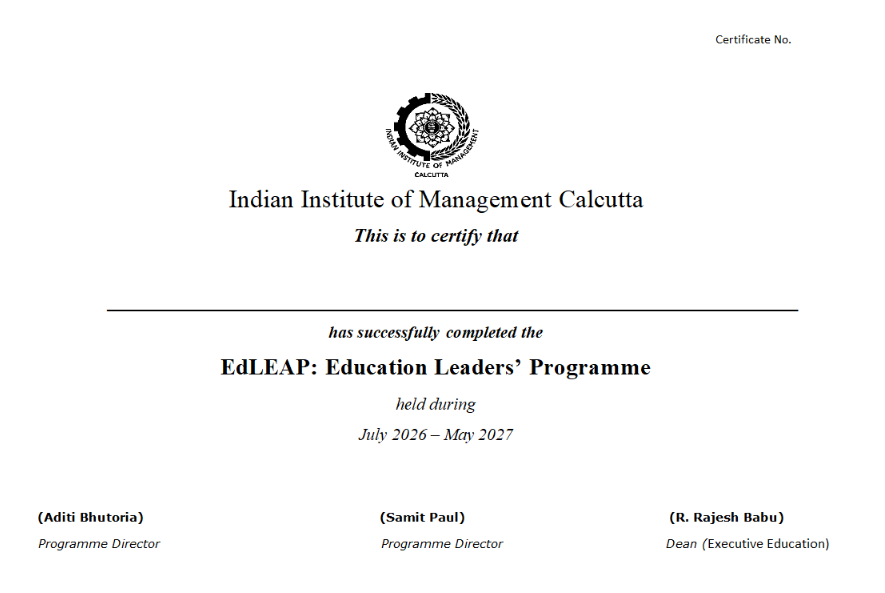
Programme Sample Certificate
Alumni Status
- LDP participants who complete the programme successfully become the Alumni of IIMC Executive Education, which currently has over 35,000 members.
- LDP Alumni are given an email-id in the IIM Calcutta domain.
- LDP Alumni can register in the IIM Calcutta Alumni portal either with this email-id or with their personal email-ids. The IIM Calcutta Alumni portal is a common platform for Alumni of all programmes of the Institute to interact with each other and stay connected with the Institute.
- The Institute shares newsletters, important news and articles about the Institute and its activities, the achievements of the Institute's faculty, staff, students and alumni, upcoming events and programmes etc., on the portal.
- Alumni can post their achievements, write about jobs or LIVE project opportunities for other alumni to see.
- The IIM Calcutta alumni network can also be accessed on mobile phones through the mobile app.
- Executive Education Alumni are entitled to a discount of 5% on the programme fee if they opt to do another LDP.
- By using the different features of the IIM Calcutta portal, alumni across programmes can engage with each other in many meaningful ways. It is up to the alumni themselves to leverage the platform
How to Apply
For further details and for downloading the application form please visit - https://talentsprint.com/course/educational-leadership-program-iim-calcutta?utm_source=partner_referral&utm_medium=website_banner&utm_campaign=iimc-edleap-partner_referral-awareness-partner_website_visitors&utm_content=iimc-edleap-partner_referral-website_banner
Whom to contact
Name - Jivin C Jose
Email ID - jivin[dot]c[dot]jose[at]accenture[dot]com
Phone - 9652950077