




Programme Overview
The myths, promises, and realities surrounding business analytics need to be confronted and addressed by the senior management teams of organisations in today’s volatile business landscape. As the conventional differentiators of competitive advantage start vanishing fast, the use of data-driven intelligence has started emerging as the game changer. Understanding the emerging nature of competition, planning a roadmap for enhancing competitive capability, and visualizing the future of analytics-oriented competition have become a necessity for senior management in organisations.
Data-smart firms are developing new models of decision-making that exploit overwhelming amounts of data to make smart products and services for consumers. The potential to create value through data aggregation and analysis is huge, and firms leveraging analytics are at a vantage point in their competitive landscape. Newer sets of capabilities are required to bring value to the data gathered from all the frontline processes.
Programme Objective
This programme is targeted towards senior managers who appreciate how analytics could unleash value for the firm and its consumers.
- This program is targeted towards senior management – the segment not being adequately served by the existing bouquet of LDPs in the analytics/data science space
- The Program combines strategic aspects of Business Analytics with relevant technology-oriented operational aspects for actionable appreciation of analytics by senior management.
It would help spread the data-driven decision-making capabilities of participants.
Programme Directors


Who Should Attend
Leaders/Executives who want to drive strategic initiatives at their organisation through analytics. The inherent nature of the subject requires familiarity with high-school-level mathematics and a penchant for analytical thinking. The participants should be mentally prepared to view appropriate business problems through the lens of data and analytics to appreciate the complexities and leverage the associated opportunities.
Eligibility
Working professionals who are graduates (10+2+3 or equivalent)/postgraduates in any discipline with minimum 50% marks, with an experience profile of at least 8 years after graduation are eligible.
Eligible candidates will be selected on the basis of assessment of educational and professional background and motivation based on the application form submitted.
Programme Duration and Delivery
The duration of the programme is 7 months. The sessions will be delivered primarily through face-to-face classroom sessions on the IIM Calcutta campus and partly through live, interactive online sessions conducted through a direct-to-device platform. The online sessions will generally be scheduled once a week on select Sundays, from 9:30 a.m. to 12:30 p.m.
Three Five-days campus visits will be conducted over a span of 7 months.
Campus Immersion Dates :
- Jan 18th-22nd, 2027
- April 26th-30th, 2027
- July 12-16, 2027
Pedagogy
The pedagogy will be highly interactive, including Campus Immersion at IIMC and D2D sessions. This is a blended program which includes classroom lectures, D2D sessions, real-life case studies, group discussions, and simulations. One of the highlights of the programme is guest speaker sessions from industry experts.On – Campus visit will include sessions on aspects which require greater face to face interaction and access to other subject experts at IIM Calcutta.
Programme Content
| Module # | Module | Topics |
|---|---|---|
| 1 | The business value of data analytics | Assessing analytics & AI readiness in your business |
| Building & leading high-performance analytics and AI teams | ||
| Competing with data,analytics and AI in the age of disruption | ||
| Building a data-driven organization | ||
| 2 | Statistics for Decision-making | Applying statistical thinking to business decision-making |
| Using applied probability for managing uncertainty | ||
| Inferring population insights through data sampling | ||
| Capturing variable relationships with regression analysis | ||
| 3 | Data Preparation & Descriptive Analytics | Identifying data sources and filtering raw data for modelling |
| Extracting, cleaning, analyzing outliers and reducing dimensionality in datasets | ||
| Performing exploratory data analysis for empirical insight generation | ||
| Creating effective data visualizations for decision support | ||
| Designing experiments and preprocessing for business analysis and testing | ||
| Applying causal inference to interpret observational data | ||
| Interpreting statistical summaries for business relevance | ||
| 4 | Predictive Analytics & Machine Learning | Applying forecasting techniques for business planning |
| Using supervised learning and classification models in decision-making | ||
| Applying unsupervised learning and clustering to discover patterns | ||
| Conducting time series analysis for data-driven forecasting | ||
| Enhancing decisions with supervised machine learning models | ||
| Leveraging neural networks and deep learning for business intelligence | ||
| NLP & LLMs: Text analytics, sentiment analysis, LLM architecture overview (Transformers, GPT) | ||
| 5 | Prescriptive Analytics for Strategic Decisions | Using simulation models to explore decision outcomes |
| Applying decision analysis for individual and group choices | ||
| Solving complex problems using optimization models | ||
| Understanding strategic behavior with game theory and network effects | ||
| 6 | Applied Business Analytics Across Functions | Leading with people analytics: AI-powered workforce planning |
| Driving customer growth: AI-enabled marketing analytics & personalization | ||
| Financial leadership with AI: Forecasting, risk analytics & optimization | ||
| Operations transformation: AI-driven process optimization & efficiency | ||
| Supply chain leadership: Analytics & AI for resilient, intelligent supply chains | ||
| 7 | GenAI and Agentic AI Applications in Business | (merge with below point) |
| Using GenAI to enhance business analytics,storytelling and leadership decision-making | ||
| Generating and refining data visualizations with GenAI tools | ||
| Prompt engineering, RAG & GenAI project lifecycle | ||
| Low-Code/No-Code AI: Build with Lovable, Bolt; Automate with n8n, Zapier | ||
| Agentic AI for enterprise: Autonomous agents, multi-agent systems | ||
| 8 | Capstone Projects | Each participant will be carrying out two projects – one in the broad domain of Analytics involving AI and Machine Learning and the other on Operational Analytics. |
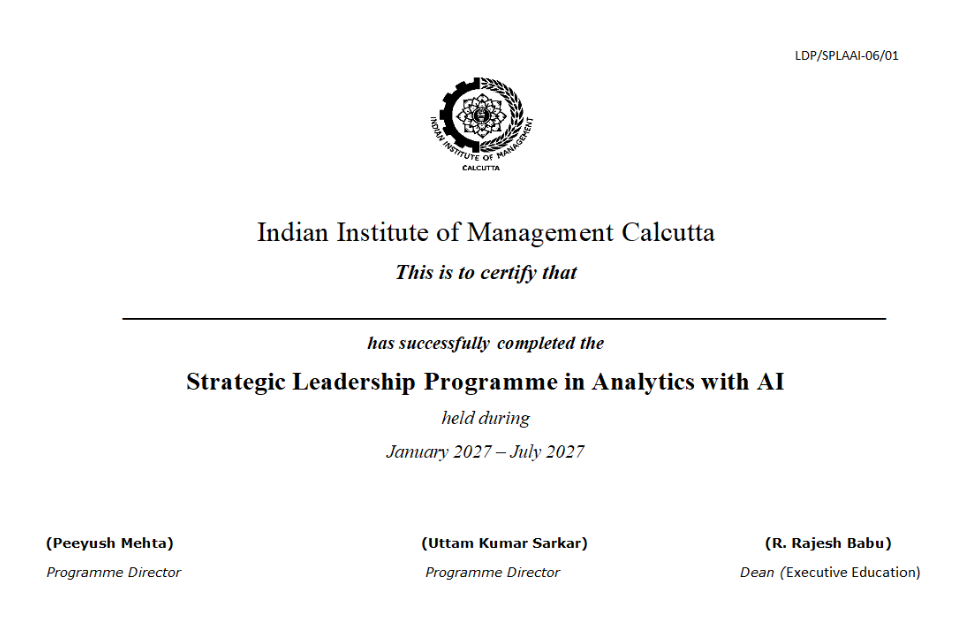
Programme Sample Certificate
Alumni Status
- LDP participants who complete the programme successfully become the Alumni of IIMC Executive Education, which currently has over 35,000 members.
- LDP Alumni are given an email-id in the IIM Calcutta domain.
- LDP Alumni can register in the IIM Calcutta Alumni portal either with this email-id or with their personal email-ids. The IIM Calcutta Alumni portal is a common platform for Alumni of all programmes of the Institute to interact with each other and stay connected with the Institute.
- The Institute shares newsletters, important news and articles about the Institute and its activities, the achievements of the Institute's faculty, staff, students and alumni, upcoming events and programmes etc., on the portal.
- Alumni can post their achievements, write about jobs or LIVE project opportunities for other alumni to see.
- The IIM Calcutta alumni network can also be accessed on mobile phones through the mobile app.
- Executive Education Alumni are entitled to a discount of 5% on the programme fee if they opt to do another LDP.
- By using the different features of the IIM Calcutta portal, alumni across programmes can engage with each other in many meaningful ways. It is up to the alumni themselves to leverage the platform
How to Apply
For further details and for downloading the application form please visit:- https://bit.ly/433J7uR
Contact Details
Name: Jivin C Jose
Email: jivin[dot]c[dot]jose[at]accenture[dot]com
Phone: 9652950077
