






Programme Overview and Objective
Mastering Agentic AI for Business takes a business-first approach to AI, Generative AI, and Agentic AI, with a focus on strategy, value creation, and enterprise adoption rather than technical development. Designed specifically for senior professionals and business leaders seeking to drive AI transformation initiatives, it moves beyond Generative AI fundamentals to autonomous agents, multi-agent systems, and enterprise deployment models.
The programme covers the end-to-end agentic AI lifecycle, from opportunity identification and business case development to deployment, governance, monitoring, and scaling. It has a dedicated focus on human-agent collaboration, multi-agent architectures, governance frameworks, and organizational transformation, with a strong emphasis on enterprise implementation. Practical workshops using leading AI and automation platforms give hands-on exposure to workflow design and agent building.
The programme helps participants:
- Develop a strong understanding of Artificial Intelligence, Generative AI, Large Language Models, and Agentic AI from a leadership perspective.
- Identify and prioritize high-impact AI opportunities across business functions and enterprise workflows.
- Build robust AI business cases using ROI, payback, risk assessment, and value realization frameworks.
- Design AI-enabled workflows that effectively balance automation, human oversight, governance, and accountability.
Programme Faculty

Who Should Attend
- This programme is ideal for mid-career professionals with 7–20 years of experience, such as Senior Managers, Consultants, Product Managers, and Business & Strategy Professionals across functions.
- This programme is also designed for senior professionals and entrepreneurs with 20+ years of experience, such as Functional Heads, Strategy Leaders, Innovation Leads, and Business Leaders driving digital and AI initiatives.
Eligibility
Minimum qualification required: Graduation or Diploma (10+2+3)
Pedagogy
The IIM Calcutta programme combines pre-recorded video lectures by the Programme Faculty with assignments, case studies, projects, quizzes, discussion boards, and assigned readings. Learners get doubt-solving support from subject matter experts and attend live module sessions by an industry expert, and the programme ends with a capstone on enterprise agentic AI strategy. It is delivered online, with an optional networking event on the IIM Calcutta campus.
Programme Content
| Pillar | S.No. | Module Name | Sub-Topics |
|---|---|---|---|
| The Rise of Agentic AI | 1 | Understanding Artificial Intelligence |
What Do We Mean by Artificial Intelligence? Traditional Software versus Artificial Intelligence How Machines Learn from Data Training a Model versus Using a Model Three Broad Ways Machines Learn Predictive Artificial Intelligence in Business From Automation to Predictive, Generative and Agentic Artificial Intelligence |
| 2 | Understanding Generative Artificial Intelligence and Large Language Models |
From Predicting to Generating The Many Forms of Generative Artificial Intelligence What Is a Large Language Model? How a Large Language Model Learns Language Patterns How a Large Language Model Generates a Response Prompts, Instructions and Context What Large Language Models Do Well Limitations of Large Language Models |
|
| 3 | Understanding Agentic AI |
From Generative AI to Agentic AI Automation, RPA, Assistants, Copilots and Agents What Makes an AI System Agentic? The Agentic Loop The Anatomy of an Agent Tools and Integrations Single-Agent, Multi-Agent and Human–Agent Systems Failure Modes, Reliability and Autonomy |
|
| From Opportunity to Business Value | 4 | Identifying and Prioritizing Agentic AI Opportunities |
The Task Is Not Always the Right Unit of Analysis What Makes a Workflow Agent-Ready? Objective Clarity and Measurable Outcomes Information, Knowledge and Tool Readiness Variability, Judgement and Exceptions Consequence, Reversibility and Verifiability Organizational and Governance Readiness Prioritizing Opportunities |
| 5 | Building the Business Case for Agentic Artificial Intelligence |
From Technology Proposal to Business Case Where Does Agentic Artificial Intelligence Create Value? Establishing the Baseline and Counterfactual Quantifying Productivity, Capacity and Quality Benefits Revenue, Customer and Risk-Reduction Benefits Understanding the Full Cost Stack Return on Investment, Payback and Scenario Analysis Pilot Economics, the Productivity J-Curve and Scaling |
|
| From Workflow Design to System Readiness | 6 | Designing an Agentic Workflow |
Mapping the Current Workflow Defining the Future-State Outcome and Boundaries Automating Steps versus Redesigning the Workflow Analytical Execution, Coordination and Governance Assigning Work to Humans, AI and Deterministic Software Designing Information, Knowledge and Tool Requirements Branches, Loops, State and Exceptions Approvals, Escalation, Failure and Completion |
| 7 | Designing the Human–Agent and Multi-Agent Operating Architecture |
From Workflow Blueprint to Operating Architecture Why One Agent Is Often the Best Starting Point When Specialization Justifies Multiple Agents Common Multi-Agent Patterns Orchestration, Context and Hand-Offs Designing Human Roles and Levels of Autonomy Permissions, Separation of Duties and Accountability |
|
| 8 | Evaluating Agentic AI Systems |
Why Evaluating Agents Is Different What Exactly Should Be Evaluated? Building an Evaluation Dataset Reading Traces and Diagnosing Workflow Failure Graders and Metrics |
|
| 9 | Deploying and Operating Agentic AI Systems |
From Prototype to Real-World Deployment Deciding How Much Autonomy to Give the System Choosing the Right Technology and Delivery Approach Is the System Ready to Go Live? What Should Managers Monitor After Launch? What Should Happen When the System Goes Wrong? Learning from Experience and Improving the System |
|
| Building the Agentic Enterprise | 10 | Human Roles, Work Redesign and Organizational Adoption |
From Task Automation to Work-System Redesign Reallocating Execution, Coordination and Governance The Human Edge: Judgement, Empathy and Context New Roles and Skills in Agentic Organizations How Management and Team Coordination Change Adoption, Trust, Resistance and Overreliance |
| 11 | Governance, Responsible AI, Risk and Accountability |
Why Agentic AI Changes the Governance Problem Enterprise Risk Categories Accountability and Decision Rights Bias, Fairness, Representation and Explainability The Enterprise AI Governance Operating System Regulation and Sector-Specific Compliance |
|
| 12 | Scaling Agentic Artificial Intelligence Across the Enterprise |
From Successful Pilot to Enterprise Portfolio The Dimensions and Risks of Scale Building Reusable Enterprise Capabilities Centralized, Decentralized and Federated Operating Models Portfolio Governance, Funding and Value Realization |
|
| 13 | Strategy and Leadership for the Agentic Enterprise |
Where Does Sustainable Advantage Come From? Strategic Risks and Future Scenarios The Leadership and Board Agenda |
|
| Capstone | 14 | Capstone: Enterprise Agentic AI Strategy | The Capstone: Integrating the Complete Course |
Note: Modules/topics are indicative only, and the suggested sequence may be modified/adapted to fit the learning outcomes in coordination with the respective faculty.
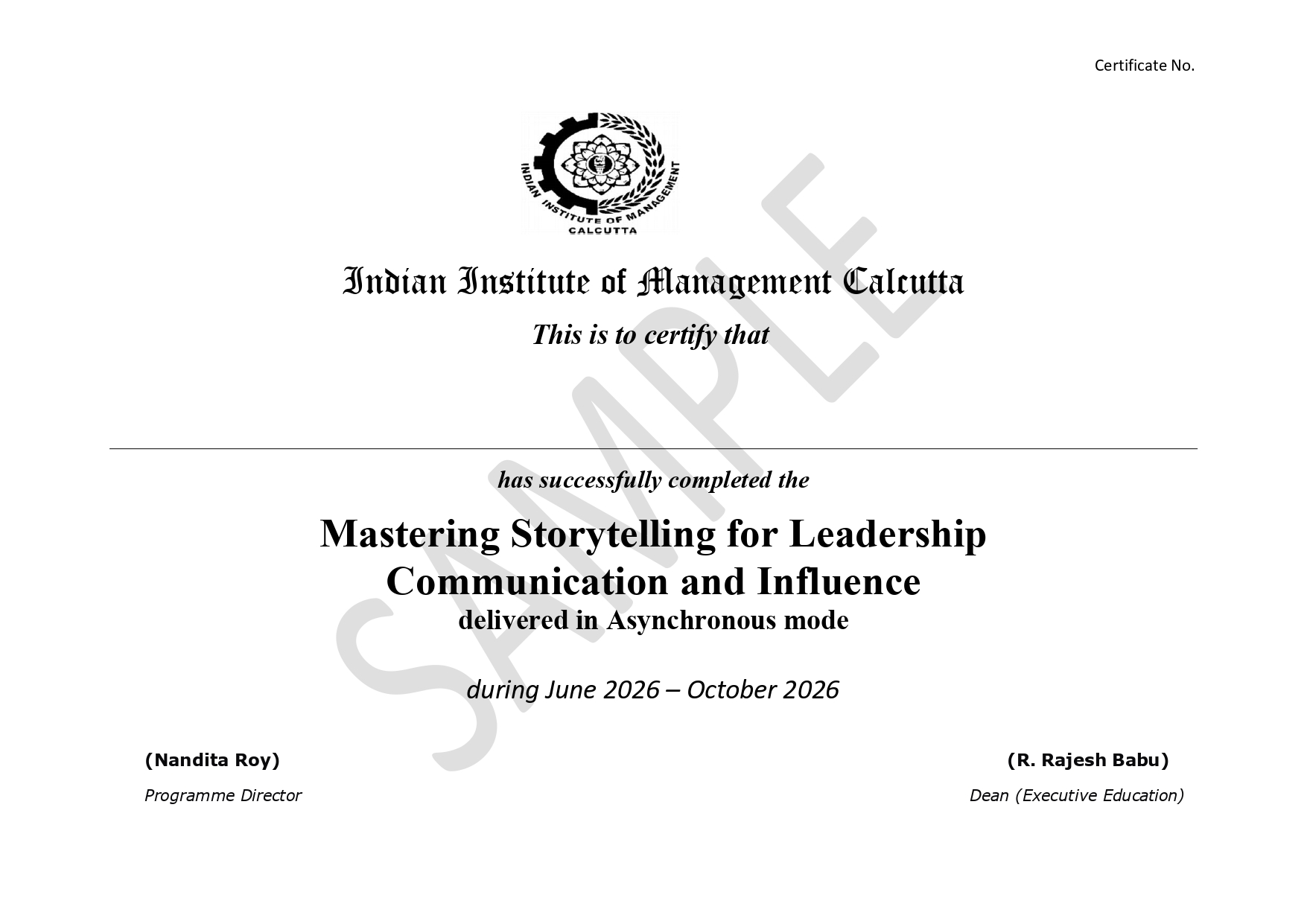
Programme Sample Certificate
How to Apply
Link - TBA
Email ID: iimc.execed[at]emeritus[dot]org
For registration and any other information, please get in touch with us at iimc.execed[at]emeritus[dot]org
Programme Gallery